
Capital does not choose between evidence and narrative. It prices the credibility of the translation, and sometimes mistakes a favourable outcome for repeatable judgement. Are we putting "lipstick on a pig" or properly translating geological uncertainty and confidence to the market?
What does an investor buy when a pre-revenue explorer raises capital? The immediate answer is geology: a target, an interpretation, a sequence of holes and the possibility of a deposit. The fuller answer is a chain of belief about what that evidence could become.
Geology is indispensable, but it is rarely investable in isolation. Before a deposit can compete for capital, evidence must be translated into a plausible future of greater confidence, workable metallurgy, approvals, financing and eventual cash flow. The market is therefore pricing both the rocks and the credibility of the translation.
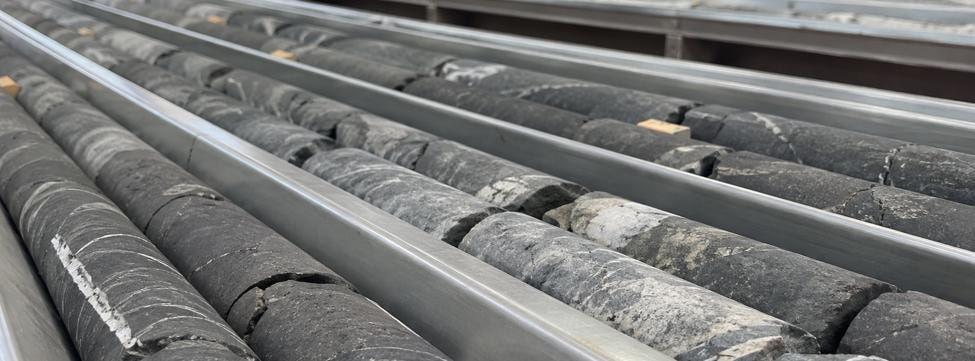
The market funds geology when geology can be connected, credibly, to a future worth financing.
Geology is necessary. Fundability decides what happens next
Australian spending confirms that capital continues to fund geological work, but it also shows where that capital concentrates. In the March quarter of 2026, seasonally adjusted mineral exploration expenditure reached A$1.094 billion, 16.1 per cent higher than a year earlier. In the original-series breakdown, A$733.6 million went to existing deposits and A$215.7 million to new deposits (Australian Bureau of Statistics [ABS], 2026).
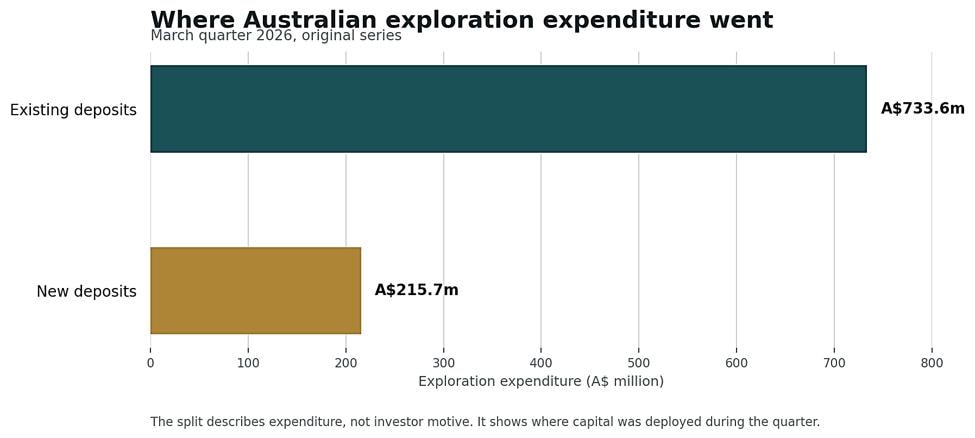
The split does not prove why investors behaved as they did. It does show that more money was deployed around known deposits than in the search for new ones during the quarter. Capital appears willing to pay for geological information, particularly where that information can reduce uncertainty around something already legible.
For a junior without operating cash flow, fundability is not a secondary corporate concern. It determines which commodity, project and geological question can be pursued now. Management may prefer the best geology in the portfolio, yet still advance the project that can attract capital in the current cycle. That is not automatically cynical; it is the operating reality of a company whose next technical decision depends on its next financing decision.
A Mineral Resource starts the argument
A Mineral Resource number feels conclusive because tonnes, grade and contained metal travel efficiently through headlines, peer tables and valuation multiples. But comparable ounces do not necessarily create comparable businesses. Depth, strip ratio, recovery, infrastructure, approvals, capital intensity and financing capacity can change the strategic meaning of the same headline inventory.
The current JORC Code requires a Mineral Resource to have reasonable prospects for eventual economic extraction. The Competent Person must consider the material assumptions affecting that prospect. Conversion to an Ore Reserve requires application of the Modifying Factors, including mining, processing, metallurgy, infrastructure, economic, marketing, legal, environmental, social and governmental matters (Joint Ore Reserves Committee [JORC], 2012). The debate in the draft JORC revision over reasonable prospects and the maturity of Modifying Factor information shows that the boundary between geological inventory and development realism remains professionally important (JORC, 2025).
Classification communicates something essential about geological evidence and confidence. It does not decide whether the next dollar should be spent, whether the project can survive dilution, or whether the market has already priced a much larger outcome. Cáceres and Emery (2026) make the link more explicit by showing how geological uncertainty can propagate into cash-flow uncertainty, and how targeted geological information can carry financial value. Drilling is most valuable when it changes a consequential decision, not merely when it adds detail.
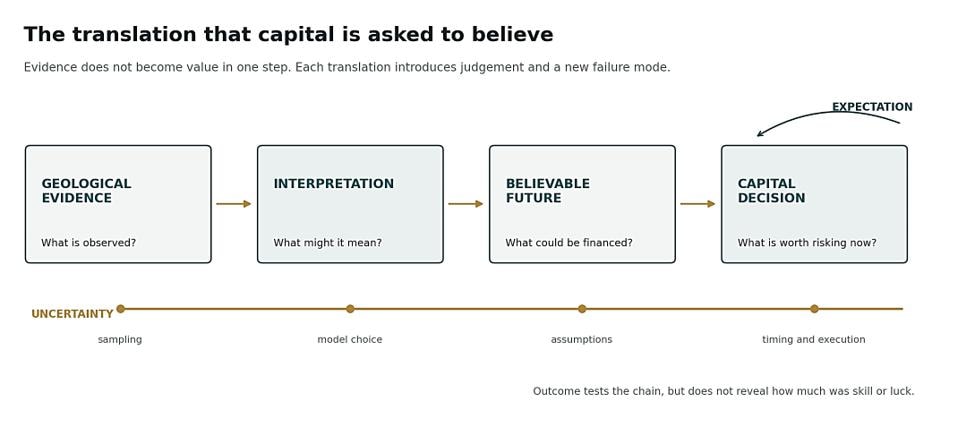
Expectation can become a project input
An Australian event study found that exploration and Resource announcements were value relevant. Larger abnormal returns were associated with smaller firms, larger implied percentage increases in Resources and positive adjectives in announcement headlines (Bird et al., 2013). The study is historical and should not be treated as a diagnosis of today's market. Its continuing relevance is the reminder that presentation and expectation can influence how geological evidence is received.
A technically sound update can disappoint when investors have already paid for a larger imagined result. At that point the issue is no longer confined to communication. Expectations can influence drill sequencing, study timing, expenditure and the threshold for announcing an update. A narrative that began as an explanation of the program can become an input to the program.
The uncomfortable question is whether the geology disappointed, or whether the expectation outran what the evidence could reasonably support. The answer will often involve management, analysts and investors, not one convenient culprit.
Management translates uncertainty
The familiar caricature places geologists on the side of truth and managing directors on the side of story. In practice, geologists interpret incomplete evidence and executives allocate scarce capital under incomplete evidence. Both make judgements. They differ mainly in audience, time horizon and consequence.
A pre-revenue managing director cannot finance a program by reciting caveats alone. Conviction is part of the job. The governance problem appears when the conditions attached to that conviction disappear: an upside case becomes the base case, a possibility hardens into a promise, or each disappointing result is absorbed into an even larger future claim.
Storytelling is not the problem. A story that no result is allowed to disprove is.
Research sits inside the capital system
An analyst's target is not a Mineral Resource estimate and should not borrow the authority of one. It is a valuation output produced within a broader capital-markets setting, with assumptions, clients, commercial relationships and potential conflicts that need to remain visible.
ASIC's review of sell-side research and corporate advisory found poor and inconsistent practices in some firms, including variation in research funding, insufficient separation between research and corporate advisory, and mixed conflict disclosure (Australian Securities and Investments Commission [ASIC], 2016). ASIC later warned that an analyst is highly unlikely to have a reasonable basis for publishing a Mineral Resource or Ore Reserve estimate when the company has not considered it appropriate to declare or update one (ASIC, 2020).
The issue remains current. In July 2026, ASIC proposed a shorter, principles-based version of Regulatory Guide 264 intended to support capital raising while preserving conflict management, research integrity and independence (ASIC, 2026). The proposal does not show that research is inherently biased. It confirms that useful research and commercial proximity must be governed together.
A model containing an assumed future Resource may still be useful, provided the reader can distinguish company disclosure from analyst inference and identify the future events required for the valuation to survive.
Luck, brilliance and the outcome problem
Markets price people as well as projects. A successful discovery record can justifiably increase confidence in a team, but the size of that premium is difficult to calibrate. One result may reflect repeatable process, superior opportunity selection, favourable timing, luck, or some mixture of all four.
Decision research describes outcome bias: people judge the quality of a decision more favourably after a good outcome, even when the information available at the time of decision is unchanged. The original finding has been replicated in a much larger preregistered study, although neither study concerns mineral exploration directly (Baron & Hershey, 1988; Aiyer et al., 2023).
Evidence from petroleum exploration, an adjacent rather than identical domain, also cautions against removing luck from the story. Milkov and Navidi (2019) analysed 8,906 conventional exploration wells and attributed part of the variation in company success rates to luck, with its influence greatest in frontier settings. Those percentages should not be transferred to mineral exploration. The broader lesson is that sparse, noisy outcomes make skill difficult to separate from chance.
Brilliance may be better observed in the process before the discovery: creating enough well-chosen opportunities, stating probabilities honestly, preserving capital through failure, recording why decisions were made and learning faster than the narrative changes.
A better decision conversation
A Resource update should be judged not only by the amount of metal added, but by whether the decision improved. Boards, technical teams, analysts and investors can make that assessment more disciplined by asking the same six questions before the market supplies an outcome.
What, then, is the market funding?
The market funds geology, management, timing and narrative in combination. Geology constrains what can credibly be claimed. Management decides which uncertainty deserves scarce capital. Timing determines whether that claim can attract funding. Narrative allows investors to imagine a future that does not yet exist.
The disruptive position is not that story should be removed from exploration. That is impossible. It is that the story must remain attached to evidence, its assumptions must remain visible, and a disappointing result must still be allowed to change the decision.
A successful team may have been brilliant, lucky or both. A disappointing Resource update may reveal less about geological failure than about an expectation gap. The quality of judgement is clearest when the decision can be examined before the outcome rewrites its history.
Do not ask only how many ounces were added. Ask what became more believable, and whether the evidence justified it.
This article was informed by a private discussion with a Perth-based Managing Director of a junior exploration company listed on the ASX. No quotation, close paraphrase, employer, project, transaction or identifying detail from that discussion is published. The contributor material is treated as background only pending confirmed publication permission.
The article is an editorial examination of decision-making under uncertainty, not investment advice and not an allegation about any company, analyst or adviser. The petroleum study is used as an adjacent-domain prompt, not as a mineral-exploration success-rate estimate. ASIC's July 2026 RG 264 proposal was consultation material at the publication cut-off and should not be described as operative guidance. The JORC Code, 2012 Edition remains the operative code at the publication cut-off; the 2025 material cited is a draft-review summary. Evidence and regulatory status checked to 22 August 2026.
Australian Bureau of Statistics. (2026, June 2). Mineral and petroleum exploration, Australia, March 2026. ABS.
Australian Securities and Investments Commission. (2016). Sell-side research and corporate advisory: Confidential information and conflicts (Report 486). ASIC.
Australian Securities and Investments Commission. (2020, December). Corporate Finance Update – Issue 3: Misleading statements by research analysts. ASIC.
Australian Securities and Investments Commission. (2026, July 23). ASIC moves to simplify sell-side research guidance to support capital raising activity. ASIC.
Aiyer, S., Kam, H. C., Ng, K. Y., Young, N. A., Shi, J., & Feldman, G. (2023). Outcomes affect evaluations of decision quality: Replication and extensions of Baron and Hershey's (1988) outcome bias Experiment 1. International Review of Social Psychology, 36(1), Article 12.
Baron, J., & Hershey, J. C. (1988). Outcome bias in decision evaluation. Journal of Personality and Social Psychology, 54(4), 569–579.
Bird, R., Grosse, M., & Yeung, D. (2013). The market response to exploration, resource and reserve announcements by mining companies: Australian data. Australian Journal of Management, 38(2), 311–331.
Cáceres, A., & Emery, X. (2026). The financial value of geological data acquisition: Optimizing mining investments by mitigating geological uncertainty. Mineral Economics.
Joint Ore Reserves Committee. (2012). Australasian Code for Reporting of Exploration Results, Mineral Resources and Ore Reserves: The JORC Code, 2012 Edition. JORC.
Joint Ore Reserves Committee. (2025). Draft JORC Code: Survey feedback and summary of changes 2024 to 2025. JORC.
Milkov, A., & Navidi, W. (2019). The role of serendipity, randomness and luck in petroleum exploration. AAPG Search and Discovery.
The first cohort of contributors is forming now.
Contribute Your Experience